
Reviews by Daniel McKay
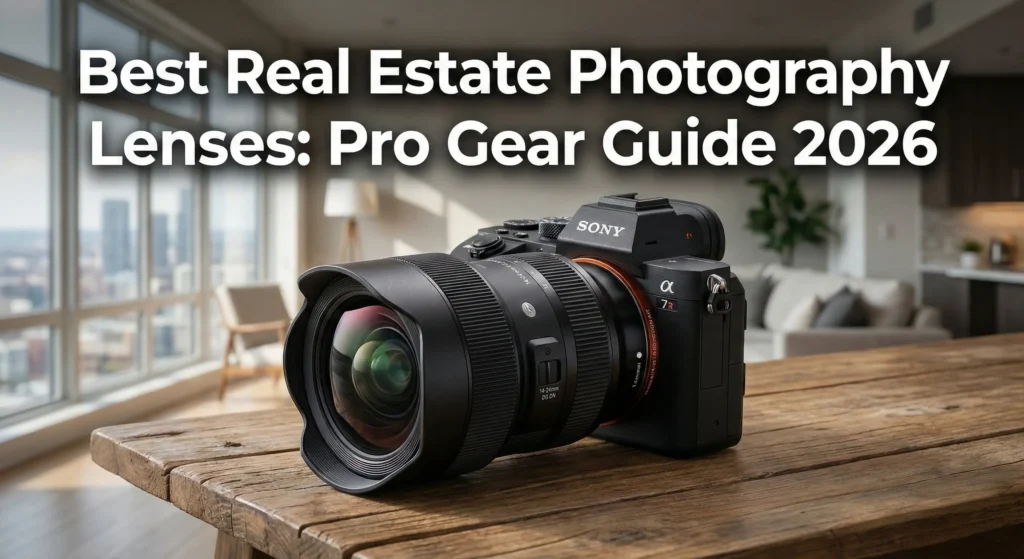
Best Real Estate Photography Lenses: Pro Gear Guide 2026
Choosing the best real estate photography lenses is the most critical factor for success in the property market this year. In 2026, home buyers expect high-quality, immersive visuals before they even visit a house in person. Specifically, a high-quality wide-angle lens allows you to capture an entire room in a single frame. Consequently, these images make spaces feel larger, brighter, and more inviting to potential clients. However, choosing the wrong focal length can lead to distorted walls and unhappy agents. This guide will help you invest in the right glass to maximize your business earnings. Get started with our expert picks below.
Why You Need the Best Real Estate Photography Lenses
Specifically, the best real estate photography lenses act as a direct investment in your professional services. When you photograph a luxury listing, your gear must handle difficult lighting and tight spaces. Real estate work often involves shooting toward bright windows while trying to preserve detail in dark corners. Therefore, you need optics that provide excellent contrast and minimal lens flare. Moreover, a professional lens ensures that your vertical lines remain perfectly straight. If the walls in your photos look curved, your work will appear amateurish. Consequently, top-tier agents will look for a more skilled specialist.
In addition to image quality, modern lenses offer features that speed up your workflow significantly. For instance, many of the latest wide-angle lenses are significantly lighter than older models. This is particularly helpful when you move a tripod through multiple rooms in a single afternoon. Furthermore, 2026 has seen a surge in hybrid property marketing. This means clients now want 4K video walk-throughs alongside their still photos. Therefore, your lenses must perform well for both photography and cinematography. Selecting the best real estate photography lenses with silent autofocus is essential for modern professionals.
The Best Real Estate Photography Lenses for 2026
1. Sony FE 16-35mm f/2.8 GM II
The Sony FE 16-35mm f/2.8 GM II is widely regarded as the gold standard for E-mount users. Sony updated this lens to meet the demands of high-resolution sensors like the Alpha 7R V. Specifically, it offers incredible sharpness from corner to corner. In real estate, the corners of your frame are just as important as the center. Therefore, this lens ensures that architectural details remain crisp throughout the entire image. Moreover, it is significantly lighter than the original version, which improves your mobility on-site.
This lens is particularly effective for professional video tours. Because it features four XD linear motors, the autofocus is both fast and completely silent. Consequently, you can capture smooth transitions from a kitchen island to the backyard without mechanical noise. Furthermore, the 16-35mm range is incredibly versatile. You can use the 16mm end for tight bathrooms and the 35mm end for detail shots. Therefore, it is one of the best real estate photography lenses for any professional photographer in 2026.
2. Canon RF 10-20mm f/4L IS STM
For Canon users, the RF 10-20mm f/4L is a revolutionary tool for property work. It is currently one of the widest rectilinear lenses ever made for a mirrorless system. Specifically, the 10mm focal length provides an immersive view that makes small apartments feel spacious. In contrast to older ultra-wide lenses, it produces very little barrel distortion. Therefore, the architectural integrity of the home is always preserved. This makes it a favorite for agents who specialize in urban condos and tiny homes.
In addition to its wide field of view, it features built-in image stabilization. While real estate photographers usually use tripods, the stabilization is a game-changer for handheld video. Consequently, you can create smooth, cinematic walk-through clips for social media without a bulky gimbal. Furthermore, the lens is surprisingly compact and weighs only 570 grams. Because it is part of the L-series, it is built to withstand years of professional use. Therefore, it represents a top-tier choice for any serious Canon real estate shooter.
3. Sigma 14-24mm f/2.8 DG DN Art
The Sigma 14-24mm f/2.8 Art is a fantastic alternative for photographers who prioritize optical purity. Many professionals believe this is the sharpest wide-angle zoom ever created for mirrorless cameras. Specifically, it features advanced glass elements that virtually eliminate chromatic aberration. Consequently, you will not see purple fringing around bright windows or light fixtures. This saves you hours of tedious editing time in post-production. Moreover, the 14mm focal length provides that extra bit of width that a standard 16mm lens lacks.
However, there is one technical detail you must consider before purchasing. Because the front element is bulbous, you cannot use standard screw-on filters. Therefore, if you need a polarizer to remove reflections from glass, you must use a specialized rear filter holder. Despite this, the build quality is impeccable. It is fully weather-sealed and feels like a precision instrument. Consequently, it is a favorite for architectural photographers who need the highest possible resolution.
4. Viltrox AF 16mm f/1.8 FE
The Viltrox 16mm f/1.8 has become a disruptor in the 2026 market. It is one of the best real estate photography lenses for those on a budget. Specifically, it offers the performance of a high-end Sony prime for about one-quarter of the cost. The lens features a unique LCD screen on the barrel that displays focus distance and aperture. This is incredibly helpful when you work in low-light basements or attics. Furthermore, the f/1.8 aperture is excellent for detail shots where you want a slightly blurred background.
The image quality is surprisingly high, with excellent sharpness across the frame. Consequently, you do not have to sacrifice professional results to save money. Moreover, the autofocus is fast and compatible with all modern Sony tracking features. If you are just starting your real estate photography business, this lens offers an incredible return on investment. Therefore, it is a highly recommended choice for smart shoppers in the industry.
5. Canon TS-E 24mm f/3.5L II (Tilt-Shift)
If you want to compete at the highest level of luxury real estate, you must consider tilt-shift lenses. Specifically, the Canon TS-E 24mm f/3.5L II is a legend in the industry. These lenses allow you to shift the glass vertically to correct perspective distortion in-camera. Consequently, you can photograph tall buildings or high ceilings without tilting the camera upward. This ensures that every vertical line in your photo is perfectly straight.
Furthermore, using a tilt-shift lens signals to clients that you are a high-end specialist. Because these lenses are manual focus and difficult to master, they represent a barrier to entry for amateurs. Therefore, you can often charge higher rates when you include tilt-shift photography in your packages. In 2026, many photographers use adapters to put these classic lenses on Sony or Nikon bodies. Consequently, they remain a vital part of the professional architectural toolkit.
Key Technical Factors for Property Lenses
When searching for the best real estate photography lenses, you must understand the difference between rectilinear and fisheye optics. You should always choose rectilinear lenses. Specifically, these are designed to keep straight lines straight. In contrast, a fisheye lens will curve the walls of a room, which looks unprofessional for real estate. Furthermore, pay attention to the sunstar quality of the lens. When you photograph a room with lights on, a good lens will create pleasing stars around the light bulbs instead of messy flares.
Another factor is the sweet spot of your lens. Most real estate photographers shoot at apertures between f/8 and f/11 on a tripod. Therefore, you do not necessarily need a lens with a fast f/1.4 aperture. Specifically, you are paying for corner-to-corner sharpness and low distortion at those mid-range apertures. Moreover, ensure your lens has a high-quality coating to handle veiling glare. This happens when sunlight from a window washes out the contrast in your photo.
Final Thoughts on Property Gear
Specifically, the best real estate photography lenses in 2026 are those that help you work faster. Because the real estate market moves quickly, you need gear that allows you to deliver photos within 24 hours. Consequently, choosing lenses with minimal distortion reduces your time spent in Lightroom. Moreover, using lenses that your camera’s firmware can recognize allows for automatic corrections. In addition, you can check Zillow’s photography guidelines for industry standards.
If you want to learn more about camera bodies, read our guide on the best Sony mirrorless lenses. In conclusion, your lenses are the foundation of your business. Invest in quality glass today.
Affiliate disclosure: Some pages may contain affiliate links. If you buy through those links, we may earn a commission at no extra cost to you.