
Reviews by Daniel McKay
Rode Wireless PRO DJI Mic 2 Comparison (2026)
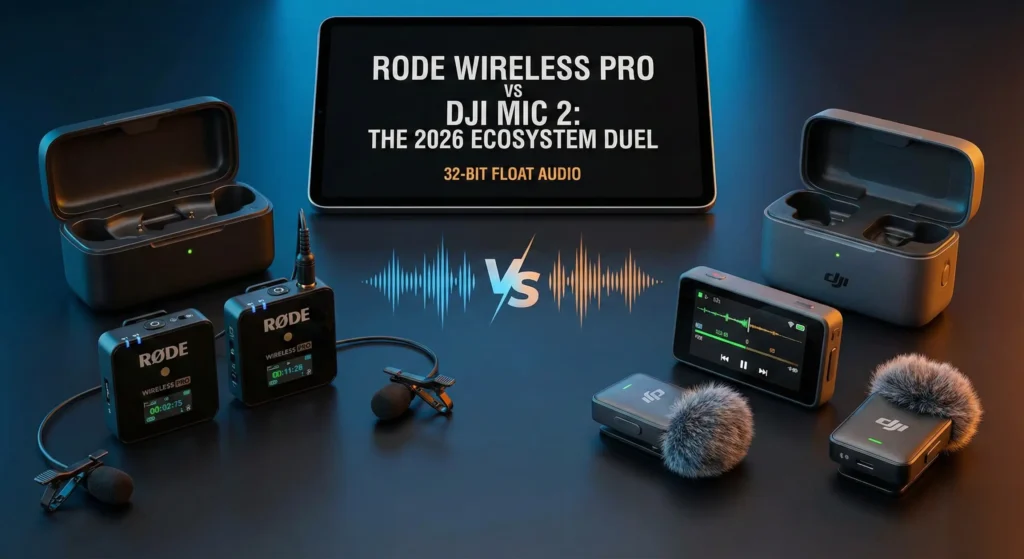
Rode Wireless PRO DJI Mic 2 comparisons are currently the most debated topic among professional content creators. Both systems represent the absolute pinnacle of wireless audio technology in 2026. Consequently, choosing between them requires a deep understanding of your specific production needs.
Furthermore, both brands offer 32-bit float internal recording and exceptional signal stability. Notably, the final choice often comes down to your preferred ecosystem and post-production workflow.
Key Takeaways
- Workflow Focus: DJI prioritizes speed and smartphone integration, while Rode focuses on professional cinema standards and timecode.
- Timecode Support: The Rode system includes a dedicated internal timecode generator for easy multi-cam syncing in post-production.
- Accessories: Rode includes professional locking lavaliers and a rugged case, whereas DJI features a unique magnetic mounting system.
Comparing the Rode Wireless PRO DJI Ecosystems
When evaluating the Rode Wireless PRO DJI options, you must consider the design philosophy of each brand. DJI has created a sleek, touchscreen-driven interface that appeals to solo vloggers.
Furthermore, their magnetic clips are incredibly fast to deploy on set. Notably, the DJI transmitters can pair directly with smartphones via Bluetooth.
Consequently, it is the most efficient choice for social media managers and mobile journalists. The DJI Mic 2 also features a transparent design that looks very modern. Furthermore, the charging case is compact and charges the units very quickly.
Therefore, it is the ideal companion for travel creators. Notably, the system is very easy to use for beginners who do not want to navigate complex menus.
Professional Features and Timecode Accuracy
In the Rode Wireless PRO DJI battle, Rode takes the lead for traditional filmmaking and commercial work. The Wireless PRO includes advanced timecode capabilities that simplify post-production syncing.
Furthermore, the transmitters feature locking 3.5mm inputs to prevent accidental cable disconnects. Notably, the included Charging Case is rugged enough for international travel.
Consequently, it remains the primary choice for documentary crews who require a fail-safe professional system. Rode also provides two high-quality Lavalier II microphones in the box.
Therefore, you do not need to buy external mics to get a professional look. Furthermore, the Rode Central software allows for deep customization of the device settings. Notably, the timecode implementation is compatible with all major professional cameras.
Sound Quality and Audio Signatures
Furthermore, we must discuss the sound signature in the Rode Wireless PRO DJI comparison. The DJI Mic 2 has a very bright and crisp high-end.
This helps dialogue cut through background noise, especially on smartphone speakers. Consequently, it is excellent for TikTok and Instagram creators.
However, the Rode Wireless PRO offers a more neutral and broadcast sound signature. Notably, it captures more low-mid frequencies, which makes voices sound more authoritative.
Therefore, it is better suited for cinematic projects and professional interviews. Additionally, both systems record 32-bit float backup files.
Consequently, you can always fix your audio levels if the subject gets too loud. Furthermore, the noise floor on both units is incredibly low for such small devices.
Range and Signal Reliability Benchmarks
Range is another critical factor in the Rode Wireless PRO DJI debate. Both systems use 2.4GHz digital transmission. DJI claims a range of up to 250 meters in open spaces.
Furthermore, their new encryption ensures a very stable signal in crowded urban environments. Notably, Rode also offers a range of over 250 meters with its Series IV transmission.
Consequently, you can walk away from the camera without worrying about audio dropouts. Furthermore, both receivers feature a safety channel that records at a lower volume.
Therefore, you have multiple layers of protection against signal failure. Notably, DJI’s magnetic mounting makes it easier to place the mic closer to the mouth.
Consequently, you get a better signal-to-noise ratio in loud environments.
Battery Life and Charging Efficiency
Furthermore, you should consider battery performance in your Rode Wireless PRO DJI decision. The DJI Mic 2 offers approximately 6 hours of use per transmitter.
Its case provides an additional two full charges. Consequently, you get roughly 18 hours of total filming time.
Rode, however, offers 7 hours per unit and a total of 21 hours with the case. Notably, both systems charge via USB-C.
Therefore, you can quickly top them up between locations. Furthermore, the Rode case is slightly larger but more protective.
Consequently, it is better for being tossed into a heavy camera bag. Notably, DJI’s transmitters charge faster in the case during short breaks.
The Importance of User Interface
Notably, the Rode Wireless PRO DJI units differ significantly in their physical controls. The DJI Mic 2 features a bright OLED touchscreen and a physical wheel.
Consequently, you can change your gain or toggle noise cancellation in seconds. Rode uses a more traditional button-based system on the receiver.
Furthermore, you often need to use the Rode Central mobile app for advanced settings. Notably, some users find the DJI screen much more convenient during a fast-paced shoot.
Therefore, if you are a solo operator, you might prefer the DJI interface. However, the Rode system is more set-and-forget.
Consequently, once you configure it, you rarely need to touch the receiver again.
Final Summary: Which System Wins?
In conclusion, the Rode Wireless PRO DJI Mic 2 choice depends on your final output. If you are a social media creator who needs speed and Bluetooth connectivity, buy the DJI Mic 2.
However, if you are a professional filmmaker who needs timecode and locking connectors, buy the Rode Wireless PRO.
Both brands have created world-class tools. Consequently, your audio will be professional regardless of your choice.
Furthermore, the addition of 32-bit float to both systems has made wireless audio more reliable than ever.
Notably, you are no longer limited by a single camera input. Invest in the system that fits your workflow today.
Affiliate disclosure: Some pages may contain affiliate links. If you buy through those links, we may earn a commission at no extra cost to you.