
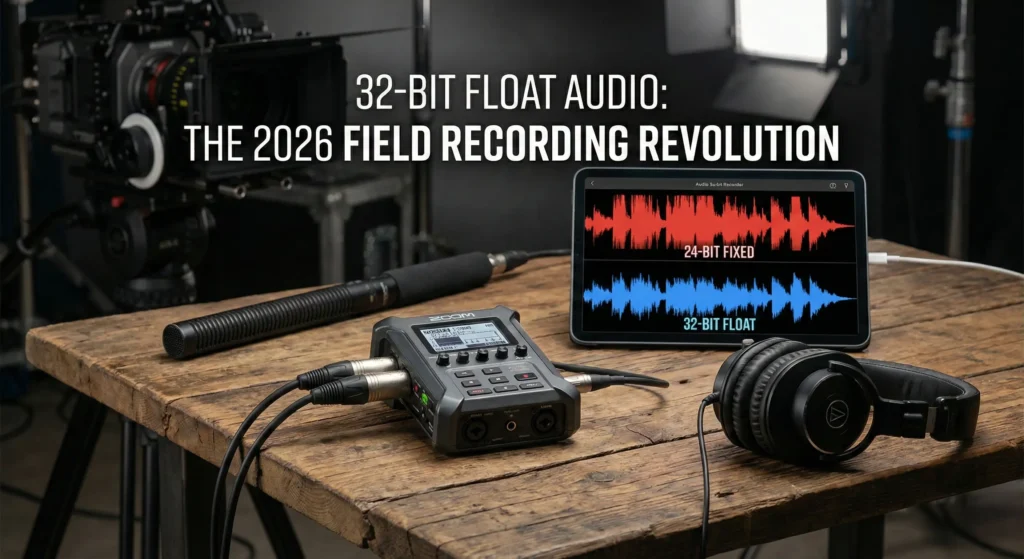
32-bit float audio worth debates have fundamentally changed how every modern filmmaker approaches field recording and sound safety. In the past, you had to watch your levels with extreme anxiety. One loud scream could ruin an entire take. However, 32-bit float technology has removed this technical barrier entirely. Consequently, you can now record unpredictable sound sources with total confidence. Furthermore, this innovation allows you to focus on the visual composition of your shot. Notably, understanding this technology is essential for anyone upgrading their audio kit in 2026. Therefore, you must evaluate if your current 24-bit system is still sufficient.
Key Takeaways
Infinite Dynamic Range: This format offers over 1,500 dB of range, making digital clipping physically impossible during recording.
Post-Production Recovery: You can recover “blown out” or extremely quiet audio in your editor without adding distortion or hiss.
Workflow Efficiency: Eliminating manual gain staging allows solo operators to work much faster on busy, unscripted film sets.
Understanding the 32-bit Float Audio Worth for Solo Creators
The true 32-bit float audio worth becomes clear when you work alone. Solo creators must manage lighting, focus, and framing simultaneously. Consequently, monitoring audio levels often becomes an afterthought. However, a 32-bit recorder acts as a perfect safety net. Therefore, you do not need to ride the gain knob during an interview. Furthermore, the dual A/D converter architecture captures every detail of the sound. Notably, this technology records the quietest whispers and loudest shouts with equal clarity. Consequently, you save hours of stress on every production day. In addition, your final mix will sound much more professional.
The Physics of Unclippable Sound
Notably, standard 24-bit audio has a fixed ceiling. If the sound exceeds 0 dBFS, the waveform clips. This results in permanent digital distortion. However, 32-bit float uses a mathematical “floating point” system. Consequently, the ceiling is effectively moved far beyond any sound found on Earth. Furthermore, this means the data is never truly lost. Therefore, you can lower the gain in Premiere Pro or DaVinci Resolve later. The perfect waveform simply reappears without any damage. Notably, this is a massive leap forward for documentary filmmakers. Consequently, you can capture authentic moments without technical interruptions.
Why 32-bit Float Audio Worth the Storage Trade-off
Some skeptics argue that 32-bit files are too large for daily use. However, the 32-bit float audio worth far outweighs the cost of larger SD cards. In 2026, high-speed storage is incredibly affordable. Furthermore, the file size increase is only about 33% compared to 24-bit files. Therefore, the “insurance” you get is remarkably cheap. Notably, you save time in post-production by not fixing “broken” audio. Consequently, your overall project costs actually decrease. In addition, modern recorders like the Zoom F3 handle these files with extreme efficiency. Therefore, you should not let file size deter your upgrade.
Impact on Post-Production and Mixing
Furthermore, the 32-bit float audio worth is highly evident during the mixing phase. In the past, quiet recordings often suffered from a high noise floor when boosted. However, the massive dynamic range of 32-bit float keeps the noise floor extremely low. Consequently, your “normalized” audio sounds clean and professional. Therefore, you can apply heavy compression or EQ without revealing digital artifacts. Notably, this allows for more creative sound design in cinematic projects. Furthermore, the synchronization process remains identical to standard files. Consequently, your existing workflow does not need to change significantly.
Hardware Options: Zoom F3 vs. Sound Devices
If you have decided that 32-bit float audio worth is real, you need the right hardware. The Zoom F3 is currently the most popular entry-level professional choice. It is tiny and offers two XLR inputs. Furthermore, it is built like a tank for field use. Notably, it lacks gain knobs entirely because it doesn’t need them. Consequently, it is the most “set-and-forget” device on the market. For high-end productions, the Sound Devices MixPre-3 II remains the gold standard. Therefore, you can find a 32-bit solution regardless of your budget. In addition, both brands offer exceptional pre-amp quality.
Battery Life and Power Considerations
Notably, 32-bit recorders consume more power than older models. Consequently, you must plan your power strategy carefully. Furthermore, using phantom-powered microphones will drain batteries even faster. Therefore, we recommend using external USB-C power banks for long shoot days. Most modern recorders support this feature natively. In addition, always use high-quality AA batteries as a secondary backup. Notably, the 32-bit float audio worth is only realized if the device stays powered on. Consequently, a robust power solution is a mandatory part of your kit. Furthermore, many recorders feature locking power ports for safety.
Is 32-bit Float Just for Professionals?
Many hobbyists ask if 32-bit float audio worth applies to their smaller projects. In 2026, the answer is a resounding yes. Even a simple YouTube vlog benefits from unclippable audio. Consequently, you won’t ruin a great story because of a technical mistake. Furthermore, the price gap between 24-bit and 32-bit hardware has nearly disappeared. Therefore, there is no reason to buy older technology today. Notably, the learning curve is actually shorter with 32-bit float. Consequently, beginners can achieve professional results much faster than before. In addition, it builds a foundation for more complex future work.
Conclusion: The Future of Field Recording
In conclusion, the 32-bit float audio worth is proven by its widespread industry adoption. It has eliminated the most stressful part of audio recording. Consequently, you can focus more on the creative aspects of filmmaking. Furthermore, the technology is now accessible and affordable for everyone. Therefore, you should prioritize a 32-bit recorder in your next gear upgrade. Notably, your audience will notice the difference in sound quality. Consequently, your production value will reach new heights. Invest in this technology today and protect your sound forever.