
Reviews by Daniel McKay
Best Headphones for Video Editing (2026 Professional Guide)
Best headphones video editing standards have shifted toward total acoustic transparency in 2026. You cannot create a professional mix if your monitoring gear is lying to you. Many editors make the mistake of using consumer headphones that boost bass.
However, this results in a thin-sounding mix on other devices. Consequently, you must use professional studio monitors to hear the truth of your audio. Furthermore, accuracy is the only way to identify subtle clicks and background hiss.
Notably, the right headphones will save you from embarrassing mistakes in your final export. Therefore, high-quality audio monitoring is a mandatory investment for serious editors.
Key Takeaways
- Flat Frequency Response: Professional monitors provide an honest sound without artificial bass or treble boosts.
- Closed-Back Isolation: These designs block out external noise, which is essential for shared offices or cafes.
- Long-Term Comfort: High-end models feature plush pads to prevent ear fatigue during long editing sessions.
Why You Need the Best Headphones for Video Editing
Professional video editors often spend hours refining dialogue, music, and sound effects. Therefore, the best headphones video editing tools must be both comfortable and brutally honest.
If your headphones are too bright, your final mix may sound dull on televisions. Furthermore, consumer headphones often compress the sound, hiding quiet background problems.
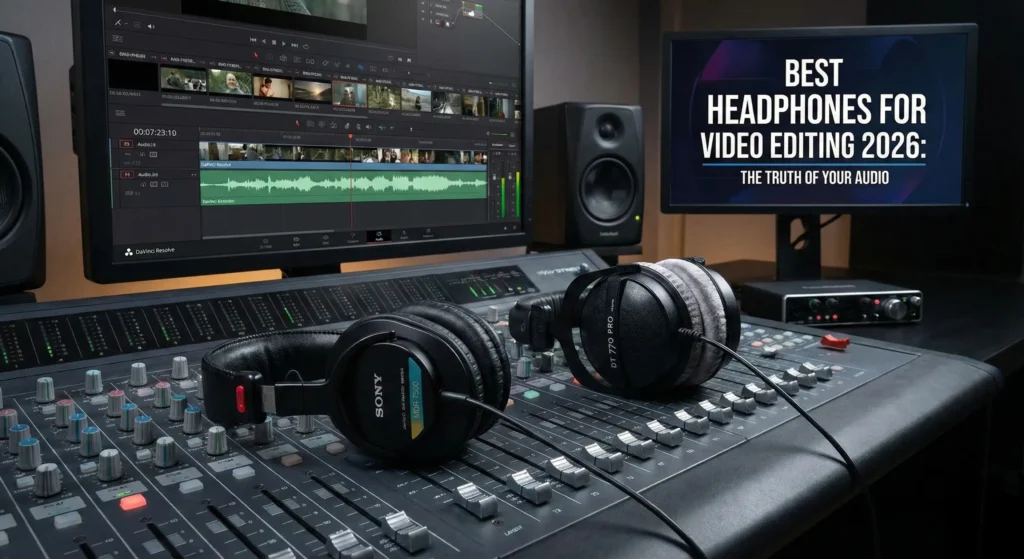
Notably, studio monitors like the Sony MDR-7506 are designed to expose these flaws. Therefore, they are the foundation of a professional post-production workflow. In addition, they allow you to place audio elements precisely in the stereo field.
Sony MDR-7506: The Reliable Standard
The Sony MDR-7506 is frequently cited as the best headphones video editing option for those who need accuracy above all else. These headphones have been a staple in professional studios for over three decades.
Furthermore, they are lightweight, durable, and foldable for travel. Notably, they feature a very revealing high-end. Consequently, you can easily identify mouth clicks, distortion, or wind rumble in dialogue tracks.
Therefore, they are the ultimate tool for dialogue editing and cleanup. In addition, they are extremely affordable for the level of precision they provide. Consequently, they are the most common entry point for professional editors.
Beyerdynamic DT 770 Pro: The King of Comfort
If long editing sessions are your reality, the DT 770 Pro is the best headphones video editing choice for comfort. These headphones are legendary for their plush velvet ear pads.
Furthermore, the closed-back design provides excellent isolation, allowing you to focus in noisy environments. Notably, the soundstage is impressively wide for a closed-back model.
Consequently, you can manage complex sound design and layered mixes with ease. Therefore, many documentary and long-form editors prefer them. In addition, the build quality ensures they survive years of daily professional use.
Open-Back vs. Closed-Back for Editors
Choosing between open-back and closed-back designs is a key decision in the best headphones video editing workflow. Closed-back models block external noise and prevent sound leakage.
Consequently, they are ideal for editing in shared spaces. However, open-back headphones offer a more natural and spacious soundstage.
Therefore, they are superior for final mixing and critical EQ decisions. Notably, sound leakage makes them unsuitable for recording or public environments. Consequently, many professionals eventually own both types for different stages of the edit.
Understanding Impedance and Audio Interfaces
Notably, the best headphones video editing professionals use often come in different impedance ratings. Low-impedance models work well directly from laptops.
However, high-impedance versions require a dedicated audio interface. Therefore, you must match your headphones to your hardware.
Furthermore, using a quality interface improves clarity, headroom, and dynamic range. Consequently, your monitoring becomes far more accurate. Therefore, consider your entire signal chain when upgrading your setup.
Avoiding the Wireless Latency Trap
While wireless headphones are convenient, the best headphones video editing setups are always wired. Bluetooth introduces latency that causes audio to drift out of sync with video.
Furthermore, wireless compression can hide subtle artifacts that matter in professional work. Therefore, wireless headphones cannot be trusted for final mixes.
Notably, a simple wired connection guarantees zero latency and perfect lip-sync. Consequently, your workflow remains accurate and stress-free.
Maintenance and Long-Term Value
Professional headphones are a long-term investment. Therefore, the best headphones video editing models offer replaceable parts such as ear pads and cables.
This dramatically extends their lifespan and lowers long-term costs. Furthermore, proper storage and basic care can keep them performing like new for years.
Consequently, the cost per year of ownership is extremely low compared to frequently replacing consumer headphones.
Conclusion: Hear the Truth in Your Edit
In conclusion, the best headphones video editing choice is the one that tells you the truth. If you need a rugged and revealing tool, the Sony MDR-7506 is unmatched.
However, if comfort and isolation are your top priorities, the Beyerdynamic DT 770 Pro is the superior option. Moving away from consumer headphones will fundamentally change how you approach sound.
Consequently, your mixes will translate perfectly across all devices. Invest in professional monitoring today and edit with total confidence.
Affiliate disclosure: Some pages may contain affiliate links. If you buy through those links, we may earn a commission at no extra cost to you.