
Reviews by Daniel McKay
Best High-CRI Lighting for Food Photography (2026)
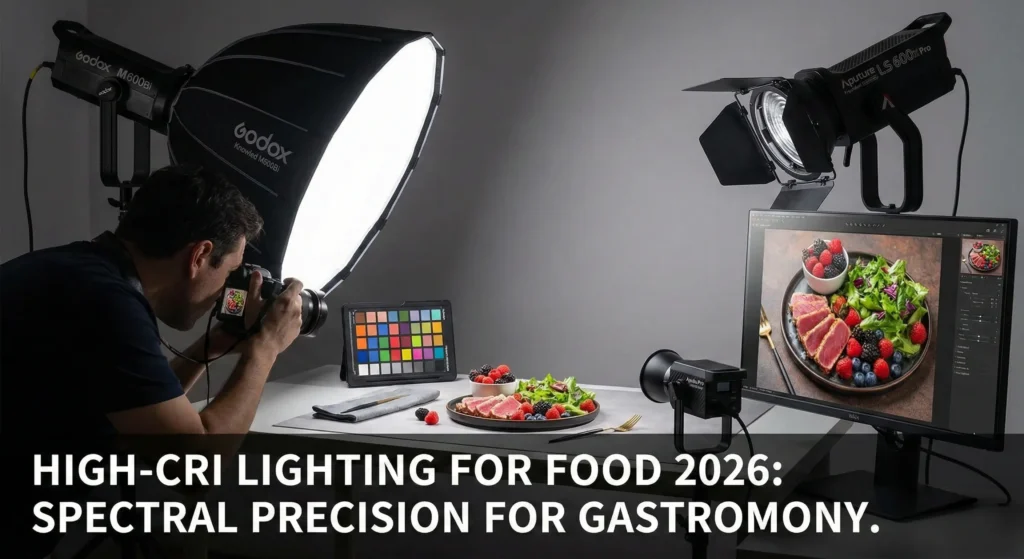
High-CRI Lighting for Food is the most essential tool for commercial photographers in 2026. Capturing the vibrant red of a strawberry or the deep green of a salad requires absolute spectral accuracy.
Consequently, you cannot rely on standard LED panels for professional food shots. This guide analyzes the top-rated lighting systems currently dominating the gastronomy industry.
We focus specifically on units that offer high R9 values and superior SSI scores. Notably, these lights ensure your food looks fresh and appetizing in every frame.
Specifically, we examine why these models represent the Best High-CRI Lighting for Food.
Key Takeaways
- Spectral Accuracy: 2026 professional LEDs achieve SSI (D56) scores above 75 for natural results.
- G/M Adjustment: Built-in tint control allows you to neutralize unwanted color casts in the kitchen.
- Silent Thermal: Fanless modes ensure your high-end commercial sets remain perfectly quiet.
Why Color Accuracy Matters in Gastronomy
In 2026, the quality of your lighting defines the value of your client’s brand. Specifically, food photography requires a light that renders colors as accurately as possible.
Notably, the High-CRI Lighting for Food market has moved beyond the simple 0–100 CRI scale. We now look at the “R9” value, which measures saturated red tones.
Consequently, if your light lacks R9, meats and vegetables will look grey and unappealing. Furthermore, modern sensors are incredibly sensitive to spectral gaps in LED chips.
Furthermore, you must consider the Spectral Similarity Index (SSI). Specifically, this metric compares an LED to a natural light source like sunlight.
Notably, the High-CRI Lighting for Food should have an SSI score above 70. Consequently, you avoid the “digital” look that often ruins professional food images.
Furthermore, high-quality LEDs prevent color banding and muddy shadows. Therefore, investing in precision lighting is a primary step for any commercial studio.
You gain more control and spend less time in post-production.
Godox Knowled M600Bi: The Color King
The Godox M600Bi has become a favorite for professional food stylists. Specifically, it offers surgical color precision with a high R9 value.
Consequently, you can capture the most delicate tones in a dish with confidence. The light features a bi-color range from 2700K to 6500K.
Notably, it maintains its spectral accuracy across the entire temperature spectrum. Furthermore, the unit includes a robust build and silent cooling.
Therefore, many consider it the Best High-CRI Lighting for Food for commercial work.
Aputure LS 600x Pro
Aputure remains a titan in the color-accurate market with the 600x Pro. Specifically, it focuses on high-contrast “hard” light that reveals texture.
Consequently, it is the primary choice for lighting glossy foods and luxury packaging. The unit features an IP54 rating for protection against spills and steam.
Notably, it integrates perfectly with the Sidus Link Pro ecosystem. Furthermore, the color science is world-class and consistent between units.
Therefore, the 600x Pro is a top contender for High-CRI Lighting for Food.
Nanlite Forza 60C (RGBLAC)
Nanlite has revolutionized tabletop work with the Forza 60C. Specifically, it uses a unique six-color LED engine (RGBLAC).
Consequently, it fills the spectral gaps that other LEDs leave behind. Notably, it achieves an incredible SSI score that rivals traditional tungsten.
Furthermore, the unit is compact enough to hide behind small plates or bottles. Therefore, it is the Best High-CRI Lighting for Food for macro and tabletop work.
You gain absolute color freedom in a portable package.
Managing Texture and Specular Highlights
Food photography is as much about texture as it is about color. Specifically, the High-CRI Lighting for Food must allow you to create beautiful specular highlights.
Notably, these are the bright reflections that make a sauce look “juicy” or a drink look refreshing.
Consequently, you should use point-source LEDs rather than large, flat panels. Furthermore, consider using specialized modifiers like optical snoots.
Notably, these allow you to project light onto very specific parts of a dish. Therefore, you gain the most creative control over your final image.
Furthermore, consider the Green/Magenta shift adjustment found in 2026 models. Specifically, this allows you to match your light to ambient fluorescent kitchen lighting.
Consequently, you avoid mismatched white balances that ruin professional portfolios. Therefore, prioritizing G/M adjustment is a smart move for any food photographer.
Conclusion: The Secret Ingredient
In 2026, your visual quality is your primary marketing tool. Choosing the Best High-CRI Lighting for Food ensures your images stand out on social media and in print.
Specifically, these lights provide the accuracy required to sell the “taste” of a dish. Whether you choose the power of Godox or the innovation of Nanlite, invest in color.
Consequently, your clients will notice the professional difference in your work.
Notably, the technology will continue to move toward even more complex LED engines. Therefore, pick a system that offers a clear growth path for your studio.
Lighting is an art form that requires the right technical foundation. By choosing High-CRI Lighting for Food, you empower your creative vision.
Start building your professional gastronomy kit today and watch your business thrive.
Disclosure: Some pages may contain affiliate links. If you buy through those links, we may earn a commission at no extra cost to you.