
Reviews by Daniel McKay
Best Mirrorless Cameras 2026: The Ultimate Professional Guide
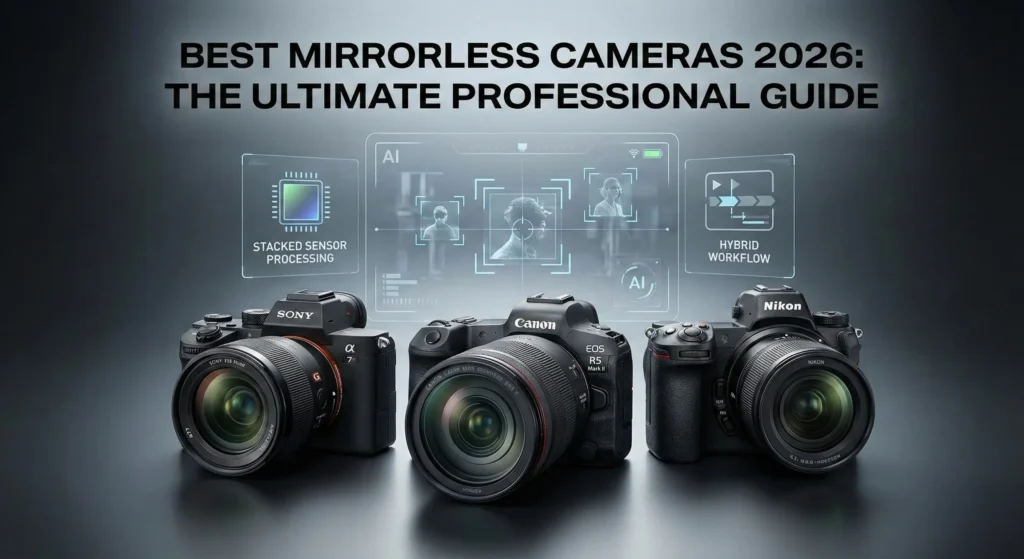
The photography landscape has shifted dramatically in recent years. Therefore, selecting from the best mirrorless cameras 2026 requires a modern understanding of imaging technology. We no longer just focus on megapixel counts. Instead, we prioritize AI-powered autofocus, stacked sensor performance, and efficient hybrid workflows. These innovations ensure that you never miss a critical moment, regardless of the environment. In this guide, we analyze the top performers that define the current market. Whether you are a studio professional or a documentarian, these tools are designed to elevate your craft.
Focus on AI-powered autofocus, stacked sensor performance, and hybrid workflows.
Flagship comparison includes Sony a7 V, Canon EOS R5 Mark II, and Nikon Z9.
Key reliability considerations include dual card slots and lens-first system planning.
Why These Are the Best Mirrorless Cameras 2026
Professional equipment must be a seamless extension of your vision. Consequently, we selected these models based on real-world reliability and technical excellence. In addition, each camera provides a distinct advantage for specific photographic niches.
2026 Flagship Comparison
Camera Model Resolution Max Burst Video Specification Target User
| Camera Model | Resolution | Max Burst | Video Specification | Target User |
|---|---|---|---|---|
| Sony a7 V | 33 MP | 10 fps | 4K/60p 10-bit | Hybrid Creators |
| Canon R5 II | 45 MP | 30 fps | 8K/60p RAW | Action/Commercial |
| Nikon Z9 | 45.7 MP | 20 fps | 8K/30p | Press/Sports |
Top performers
The Leading All-Rounder: Sony a7 V
The Sony a7 V is the most balanced tool for most professionals today. It features a refined 33MP BSI sensor that delivers exceptional image quality. Moreover, the inclusion of a dedicated AI processing unit is a total game-changer. As a result, the camera can predict human movement before it actually happens. This allows for nearly perfect hit rates during fast-paced events. Best for: Portraits, weddings, and commercial hybrid work. Key Advantage: Industry-leading AI Eye-AF. Note: The updated color science produces beautiful, natural skin tones out of the box.
The Speed Specialist: Canon EOS R5 Mark II
In contrast, the Canon EOS R5 Mark II is built for those who prioritize raw power. It utilizes a high-speed 45MP stacked CMOS sensor. Consequently, the data readout is nearly instantaneous. This allows you to capture 30 frames per second with zero rolling shutter distortion. For instance, it is the perfect choice for capturing a fast-moving athlete or a bird in flight. Best for: Sports, wildlife, and high-end video production. Key Advantage: 8K/60p internal RAW video capabilities.
The Professional Workhorse: Nikon Z9
Furthermore, the Nikon Z9 remains the gold standard for durability. It famously lacks a mechanical shutter entirely. Thus, the camera is incredibly reliable and operates in total silence. Additionally, the latest firmware updates have refined its 3D tracking. It is the preferred choice for photojournalists working in the most demanding weather conditions.
System planning note
However, you should always ensure your chosen camera features dual card slots. This provides essential data redundancy during paid assignments. Finally, remember that your lenses are just as important as the body.
Choosing the Best Mirrorless Cameras 2026 for Your Needs
In other words, you do not always need the most expensive flagship to succeed. For example, many professionals find that a mid-range body meets all their commercial requirements.
However, you should always ensure your chosen camera features dual card slots. This provides essential data redundancy during paid assignments.
Finally, remember that your lenses are just as important as the body. In fact, investing in high-quality optics often yields better results than a simple sensor upgrade. Indeed, a great lens will often outlast several camera bodies. You should always plan your system around the glass you intend to use.
Related pages
Affiliate disclosure: “Some pages may contain affiliate links. If you buy through those links, we may earn a commission at no extra cost to you.”