
Reviews by Daniel McKay
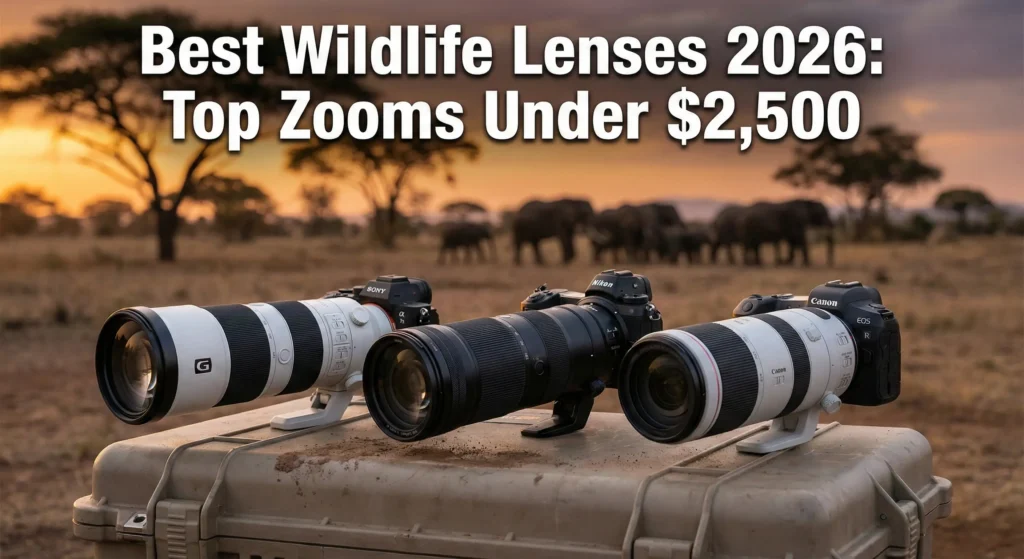
Best Wildlife Lenses 2026: Top Zooms Under $2,500
Finding the best wildlife lenses 2026 has to offer is the most effective way to capture stunning nature photography without spending your entire life savings. In 2026, the market for telephoto glass has reached a peak where high-quality zooms rival the performance of elite prime lenses. Specifically, you can now find incredible reach and speed for under $2,500, which was unthinkable just a few years ago. This guide explores the top-rated telephoto options for Sony, Canon, and Nikon systems to help you choose the right tool for your next safari or backyard birding session. Read our expert analysis below to find your perfect match.
Why High-Reach Optics are the Best Wildlife Lenses 2026 Standard
Specifically, the best wildlife lenses 2026 must prioritize focal length because animal subjects are often small, distant, and skittish. Therefore, you need a lens that allows you to fill the frame without physically intruding on the creature’s space. Consequently, 600mm has become the new benchmark for serious enthusiasts. While a 400mm lens was once sufficient, the high-resolution sensors of 2026 demand more reach to avoid heavy digital cropping. Therefore, selecting a zoom with significant magnification is the smartest move for your portfolio.
Furthermore, a longer focal length provides better subject isolation from distracting backgrounds. Specifically, it compresses the scene and creates a beautiful bokeh effect that makes the animal “pop.” This is particularly important when you are shooting in cluttered forests or busy grasslands. Moreover, modern lenses include advanced optical stabilization systems. These systems allow you to shoot at 600mm handheld with incredible clarity. Consequently, you no longer need to carry a heavy tripod everywhere you go. This mobility is a massive advantage for hikers who value the best wildlife lenses 2026 for their portability.
The Role of AI Denoising in 2026 Wildlife Photography
In the past, photographers demanded f/4 or f/2.8 apertures for low-light wildlife shots. However, 2026 has seen a revolution in AI-powered noise reduction. Software can now clean up images shot at high ISO settings with nearly zero loss of detail. Therefore, “slow” lenses with f/6.3 or even f/9 apertures are perfectly viable for professional results. Specifically, you can prioritize reach and weight over a massive, expensive aperture. This shift is why the best wildlife lenses 2026 are now more accessible to the average creator.
Top Wildlife Zoom Lenses Under $2,500
1. Sony FE 200-600mm f/5.6-6.3 G OSS
The Sony FE 200-600mm G is arguably the most popular choice among the best wildlife lenses 2026 currently available for E-mount. Specifically, it is famous for its internal zoom mechanism, which keeps the lens the same physical length at all times. Consequently, it is better balanced on a gimbal and much more resistant to dust and moisture in the field.
The autofocus performance is also stellar for professional use. It utilizes five XD linear motors to provide near-instant focus tracking on fast-moving animals. Furthermore, it is fully compatible with Sony’s 1.4x and 2.0x teleconverters for even more reach.
Key Advantage: Internal zoom provides superior balance and weather sealing.
Best For: Birding and professional field work.
2. Nikon Z 180-600mm f/5.6-6.3 VR
Nikon Z users have a fantastic native option that competes directly for the title of the best wildlife lenses 2026. Specifically, the 180-600mm VR offers edge-to-edge sharpness that is truly impressive for a zoom lens in this price bracket. Nikon designed this lens with a short 70-degree zoom throw.
Moreover, the Vibration Reduction system provides up to 5.5 stops of compensation for handheld shooting. In addition, the lens features a customizable control ring and four L-Fn buttons for instant setting changes.
3. Canon RF 200-800mm f/6.3-9 IS USM
Canon disrupted the market by releasing the RF 200-800mm, which offers more reach than any other lens in this category. Specifically, the 800mm focal length allows you to capture small birds from a safe distance without scaring them.
While an f/9 aperture might seem slow, modern AI-denoise software has made this less of a concern. Furthermore, the Nano USM motor provides silent and smooth autofocus for both stills and video.
4. Sigma 150-600mm f/5-6.3 DG DN OS Sport
Sigma’s Sport line is known for being built like a tank for professional use. The 150-600mm DG DN features extensive weather sealing and a robust metal construction, making it one of the best wildlife lenses 2026 for extreme environments.
The optical performance is also very high across the entire zoom range, with sharp images and minimal chromatic aberration even at 600mm.
5. Tamron 150-500mm f/5-6.7 Di III VC VXD
If you prioritize portability and size, the Tamron 150-500mm is a unique entry in the best wildlife lenses 2026 market. It is significantly shorter than the 600mm alternatives, making it easier to pack and carry.
The lens features a Flex Zoom Lock and a fast VXD linear motor that works seamlessly with modern animal eye-tracking systems.
How to Maximize the Best Wildlife Lenses 2026 Performance
Buying one of the best wildlife lenses 2026 is only the first step toward better photos. To get professional results, you must master your handheld technique. Specifically, keep your elbows tucked into your sides to create a stable “human tripod.” Furthermore, use the shutter speed rule as a baseline. At 600mm, you should aim for at least 1/1000s.
Additionally, use burst mode or continuous shooting. Firing a short burst of 3–5 images increases your chances of capturing a perfectly sharp frame. Moreover, check out National Geographic’s photography tips for more insight into wildlife field craft and behavior.
Final Considerations for Nature Enthusiasts
The best wildlife lenses 2026 have truly democratized nature photography. You no longer need a massive professional budget to capture the beauty of the natural world. Whether you choose the internal zoom of the Sony or the massive reach of the Canon, you are getting a world-class tool.
Specifically, remember that the lens is just one part of the equation. Patience and understanding animal behavior are equally important. In conclusion, choose a lens that fits your budget and physical comfort, then get outside and start shooting. The natural world is waiting for you.
Affiliate disclosure: Some pages may contain affiliate links. If you buy through those links, we may earn a commission at no extra cost to you.