
Reviews by Daniel McKay
Godox vs Profoto Flash (2026 Professional Comparison)
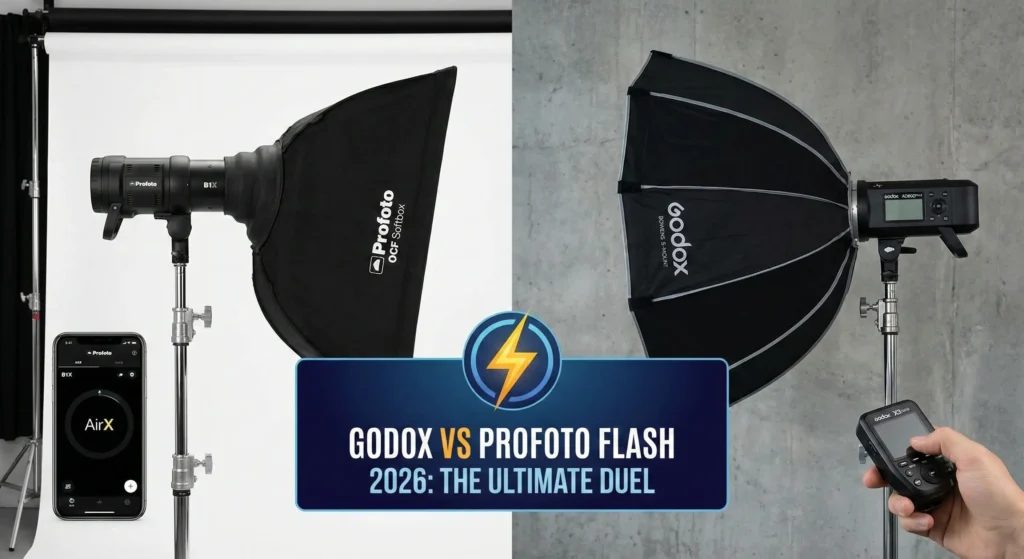
Godox vs Profoto Flash is the most debated topic in the photography community in 2026. Both brands have reached a level of maturity that challenges professional photographers. Consequently, deciding between the two requires a deep understanding of your business goals.
One brand offers unparalleled luxury and a simplified user experience. Conversely, the other provides aggressive innovation and incredible financial value. This article compares the technical nuances of both systems to help you choose.
Notably, we analyze build quality, color consistency, and ecosystem reliability for the modern creator.
Key Takeaways
- Recycle Times: Profoto maintains a slight lead in full-power recycle speed and thermal stability.
- Value Proposition: Godox allows you to build a four-light setup for the price of one Profoto unit.
- Ecosystem: Profoto offers global rental availability, while Godox provides the most modifier options.
Comparing Godox vs Profoto Flash Technology
In 2026, the technological gap has closed significantly. When you look at Godox vs Profoto Flash performance, you see impressive metrics from both.
Specifically, Godox has introduced high-end “Pro” models that rival European standards. These units feature color-coded groups and high-resolution TFT screens. Consequently, the user interface is no longer a major weakness for the brand.
Furthermore, Godox triggers like the X3 Nano offer a tactile experience that professionals love.
Conversely, Profoto has doubled down on its AirX connectivity. Notably, this technology allows your flash to synchronize with a smartphone camera. This feature is vital for photographers who deliver content for social media in real-time.
Furthermore, Profoto units like the B10X are incredibly compact for their power output. Consequently, they are the preferred choice for destination wedding photographers.
You gain a level of portability that makes travel much easier. Therefore, the brand remains the king of the run-and-gun luxury market.
Color Science and Consistency
Professional work requires absolute color accuracy. If you shoot a commercial campaign, the product color must be perfect. Consequently, this is a major factor in the Godox vs Profoto Flash debate.
Profoto flashes are famous for their stable color temperature. Notably, they stay within ±50K across the entire range. Furthermore, the light fall-off is very smooth due to the frosted glass design.
This creates a signature look that many editorial photographers prefer.
However, Godox has made massive strides with its Stable Color mode. Specifically, the AD600Pro II maintains a consistency that satisfies 95% of commercial clients.
Notably, the difference is often invisible to the naked eye. Furthermore, the cost savings are undeniable. Consequently, many studio owners choose Godox to maximize their profit margins.
You can spend the extra money on high-quality optics or marketing. Therefore, Godox represents the most logical choice for the modern entrepreneur.
Build Quality and Reliability
If you work in a high-pressure environment, your gear must survive. Specifically, Profoto builds its lights like industrial tools.
They use high-grade plastics and metals that withstand daily abuse. Notably, the buttons and dials are designed to be operated with gloves.
Furthermore, the internal components are shielded from electrical surges. Consequently, Profoto units often last for over a decade in a professional studio.
You are paying a premium for peace of mind and long-term durability.
Godox gear has improved, but it still feels slightly more consumer-grade. Specifically, the battery latches and tilt brackets are points of potential failure.
Notably, however, Godox units are so affordable that you can buy a backup for every light. Consequently, the risk of a shoot failing is still very low.
Furthermore, Godox parts are easy to find and replace. Therefore, the brand offers a different kind of reliability through redundancy.
Modifier Ecosystems
The way you shape light is just as important as the light itself. Specifically, Profoto uses a unique rubber-collar mounting system.
Notably, this allows you to slide modifiers back and forth to adjust the beam. This feature is exclusive to Profoto and offers a high level of creative control.
Furthermore, their OCF line is incredibly lightweight and portable. Consequently, building a professional light kit for travel is very straightforward with Profoto.
Godox, on the other hand, utilizes the Bowens S-mount standard. Notably, this is the most common mount in the photography world.
Consequently, you have access to thousands of affordable softboxes, snoots, and reflectors.
Furthermore, Godox has started making its own high-end modifiers that rival European quality. Therefore, you gain the most flexibility with the Godox system.
This accessibility is a major win in the Godox vs Profoto Flash comparison.
Conclusion: Which Brand Wins?
Ultimately, the choice depends on your specific career stage. If you demand the most refined experience and global prestige, choose Profoto.
Specifically, the AirX technology and industrial build are worth the investment. Consequently, you will have a tool that never lets you down on a high-stakes set.
Notably, your clients will recognize the brand and respect your professionalism.
However, if you want to maximize your creative options and profit, choose Godox. Specifically, the ADPro series offers incredible power and versatility.
Consequently, you can build a comprehensive lighting kit for a fraction of the cost. Notably, the technology is now good enough for almost any professional application.
Therefore, Godox wins the value vs performance battle in 2026. Choose the system that fits your current needs and helps you grow.
Affiliate disclosure: Some pages may contain affiliate links. If you buy through those links, we may earn a commission at no extra cost to you.